6061 offers higher yield strength and weldability, while 6063 provides superior surface finish and corrosion resistance. Choose 6061 for structural loads and 6063 for architectural or decorative applications where appearance matters.
- 6061 alloy provides higher yield strength and better weldability than 6063 alloy.
- 6063 alloy offers a smoother surface finish, making it ideal for architectural and decorative applications.
- Cost differences between the two alloys are usually minor compared to processing and finishing expenses.
- Corrosion resistance is slightly better in 6063, though both alloys perform well in most environments.
- Final selection depends on load requirements, aesthetic demands, and manufacturing constraints.
Mechanical Properties and Structural Performance
Selecting between 6061 and 6063 begins with structural capacity. 6061 alloy generally provides higher yield strength in the T6 temper. For a standard T6 extrusion, 6061 can support heavier loads before yielding. This makes it the default choice for load-bearing brackets, machine frames, and structural supports.
Consider a heavy-duty machine frame that must support a rotary spindle. The load is constant, but vibration adds a dynamic component. If you specify 6063, the beam may deflect more than expected, causing fatigue issues at the mounting points. A 6061 beam of the same cross-section will resist bending deflection more effectively. Engineers calculate safety factors based on these differences. If your design margin is tight, choose 6061. If the part is purely cosmetic or carries minimal load, such as a light interior shelf, 6063 is sufficient.
6063 alloy has slightly lower mechanical strength. In the T5 or T6 temper, it is still suitable for many applications, but it will not match 6061 in high-stress scenarios. If your part sees dynamic loads, vibration, or high static loads, 6061 is the safer choice. For low-stress decorative or architectural elements, 6063 performs well without the premium cost of higher-strength alloys.
The difference is often visible in simple bending tests. Imagine two identical aluminum bars, one made of 6061 and one of 6063. Apply a load at the center. The 6061 bar will deflect less under the same force. This behavior holds true for extruded profiles as well. When designing a bracket that holds a motor, check the allowable stress for the specific temper. 6061 T6 allows a higher allowable stress than 6063 T6. This margin matters when you need to reduce the cross-sectional area to save weight or cost. A smaller 6061 section can often replace a larger 6063 section, leading to material savings even if the alloy price is slightly higher.
Do not ignore the temper. T6 is the heat-treated condition that provides peak strength. T4 is the solution-treated condition, which is softer and more formable but lacks the full strength of T6. If a part is extruded in T4 and then machined, it may not meet the design load until it undergoes a subsequent heat treatment. Verify the temper specification on every drawing. A supplier might default to T4 for ease of extrusion, which could result in a part that fails under load if you assumed T6 properties.
Surface Finish and Aesthetic Quality
Architectural and decorative projects often prioritize surface quality over raw strength. 6063 alloy is known for producing cleaner, more uniform surfaces during extrusion. The alloy flows more predictably through the die, resulting in fewer surface defects, less tearing, and a smoother finish. This makes 6063 the standard choice for window frames, doors, and visible architectural profiles.
Look at a window frame made from 6063. The surface is flat and consistent, allowing anodizing to produce a uniform, mirror-like or satin finish. The alloy’s low carbon and silicon content helps it extrude with minimal surface stress. This predictability is why most architects specify 6063 for visible elements. The visual quality of the extrusion often determines the perceived quality of the entire building envelope.
6061 can be extruded successfully, but it may show more surface texture variations, especially in complex cross-sections. After anodizing, 6061 often has a slightly duller or more uneven appearance compared to 6063. If the final product is highly visible and requires a premium aesthetic, 6063 reduces the risk of finish rejection.
Consider a storefront door made from 6061. The metal may be strong enough to support the hardware and lock mechanism, but the anodized finish might show subtle grain patterns or uneven coloring that are acceptable on a machine housing but unacceptable on a glass-enclosed facade. The difference is subtle but noticeable to trained eyes. If the part is meant to be inspected closely, such as in a high-end office or retail space, the aesthetic premium of 6063 is worth the slight strength trade-off.
For internal or industrial applications where the surface will be painted, powder coated, or hidden, these differences matter less. A machined or painted surface can mask minor extrusion texture. In those cases, mechanical properties and cost become the primary decision drivers.
Example: A conveyor frame inside a factory. The frame is painted black. The user will never see the extrusion surface directly. The paint will cover any minor texture variations. Here, the strength and weldability of 6061 are far more important than the raw surface finish. Choosing 6061 saves money if the finish is a simple powder coat, and the strength is better suited for the moving loads.
Corrosion Resistance and Environmental Exposure
Both alloys offer good corrosion resistance, particularly when anodized. However, 6063 alloy has a slight edge in resistance to atmospheric corrosion and surface pitting. This makes it preferable for exterior architectural applications, coastal environments, and areas with high humidity.
The anodize coating on 6063 tends to be more durable and consistent. The alloy’s composition allows the anodize layer to form with a more uniform thickness and hardness. This is critical for exterior parts that face rain, UV exposure, and temperature cycles. A 6063 window frame in a coastal city will maintain its appearance for longer before showing any signs of weathering.
6061 also resists corrosion well, but it is more prone to stress corrosion cracking under specific conditions, such as high tensile stress combined with certain chemical exposures. For most outdoor architectural uses, both alloys perform acceptably when properly finished. For marine or chemical processing environments, specify additional protective coatings and verify compatibility with the specific medium.
If the extrusion will be exposed to salt air or industrial chemicals, 6063 with a thick anodize coating is a common selection. For indoor or protected outdoor applications, such as a garage door or a machine cover, 6061 is perfectly adequate. Always consider the finish system alongside the alloy choice.
Example: A chemical plant process enclosure. The enclosure sits near tanks that release mild acid mists. Even with an anodized finish, the constant exposure can degrade the surface over time. 6063’s superior corrosion resistance helps the finish last longer. However, if the environment is aggressive, you might need a more robust coating system, such as a high-solids powder coat or a specialized marine anodize. The alloy choice is the first layer of defense, but the finish system is the final barrier.
Do not assume that a higher alloy grade always means better corrosion resistance. 6063 is often the go-to for architectural corrosion performance, but 6061 can be made to perform well with the right finish. The key is matching the alloy to the exposure. For a dry indoor environment, the corrosion difference is negligible. For a wet, salty outdoor environment, it is significant.
Welding and Fabrication
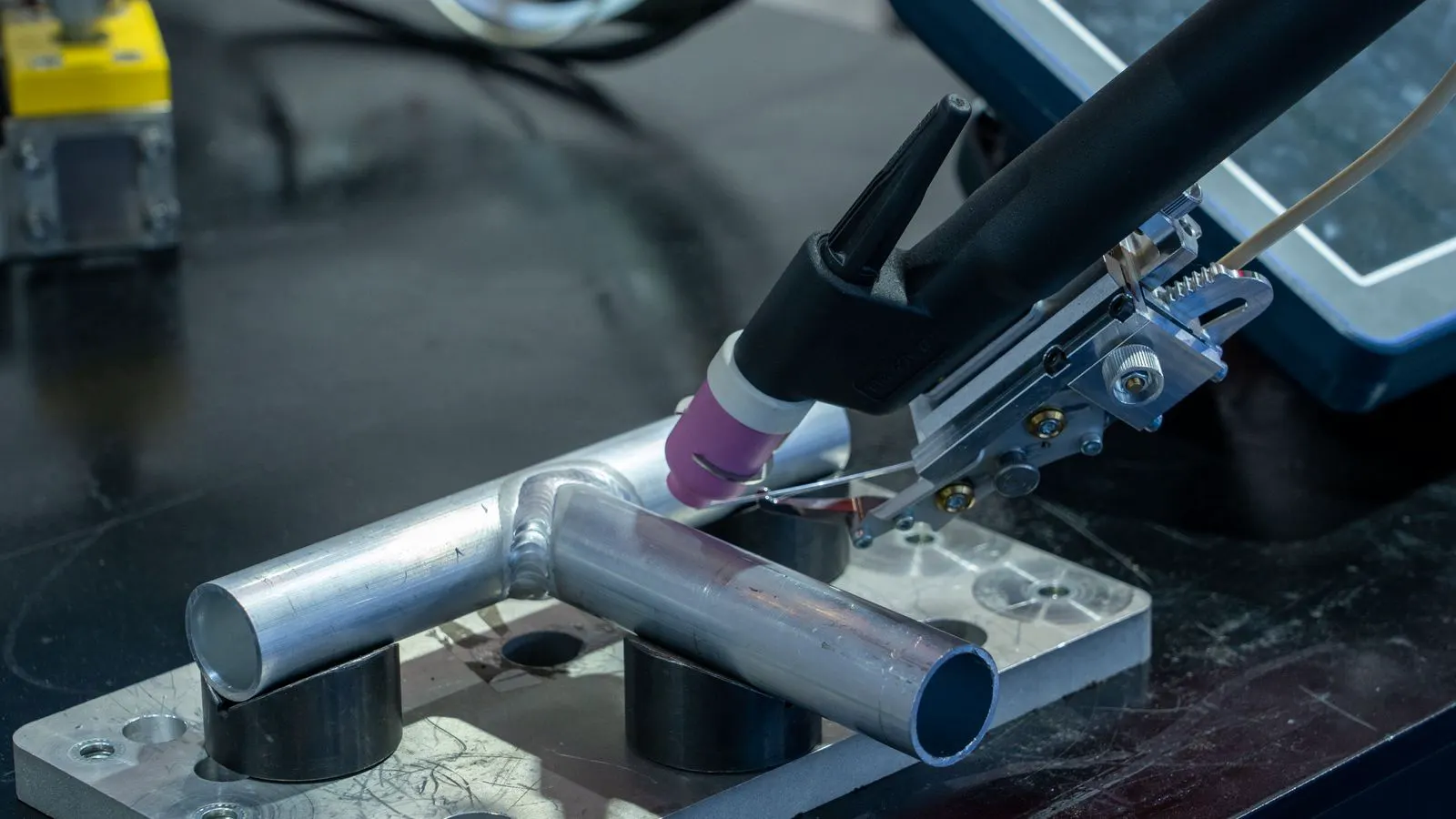
Weldability is a critical factor in many fabrication shops. 6061 alloy welds more reliably than 6063. 6061 is widely used for welded structures, machine frames, and repair work. Its weld properties are well documented, and most welders are familiar with handling it.
6061’s weldability stems from its lower silicon content. Silicon can cause brittleness in the heat-affected zone during welding. 6063 has a higher silicon content, which makes it more susceptible to hot cracking, especially in thick sections. When 6063 must be welded, welders often use preheating and careful heat input control. For high-volume welding or critical joints, 6061 is the standard choice. If your application involves extensive welding, machining, or assembly, 6061 reduces the risk of fabrication defects.
Example: A custom machine frame. The frame consists of multiple extruded profiles welded together at various angles. The joints must be strong and free of cracks. Using 6061 allows the welder to use standard processes without excessive preheating or post-weld treatment. The welds are stronger, and the risk of cracking is lower. This simplicity reduces fabrication time and cost.
Machining behavior differs slightly. 6061 machines cleanly and is easy to drill. 6063 is also machinable but can be slightly stickier in some operations. For complex parts requiring tight tolerances and secondary machining, 6061 is often preferred for its consistent cutting behavior.
Consider a part that requires precision drilling. 6061 chips away cleanly, and the drill bit does not wear as quickly. 6063 can work harden the tool edge, especially if the part is in a softer temper. This can lead to tool wear and dimensional drift. If your process involves high-volume machining, 6061’s tool life and cutting consistency can save money over time.
Cost and Supply Considerations
Material cost is a factor, but it is rarely the deciding one between these two alloys. 6061 and 6063 are both common, high-volume alloys. Price differences are usually small and fluctuate with market conditions. The bigger cost drivers are extrusion complexity, finish quality, and post-processing.
A complex 6063 extrusion with a premium anodized finish will cost more than a simple 6061 extrusion with a basic finish. The finish and complexity often outweigh the base alloy price. For high-volume runs, both alloys are readily available. For small batches or custom cross-sections, lead times may vary by supplier.
Consider the total cost of ownership. If 6063 reduces the need for additional coating or painting due to its superior finish, that can lower overall project cost. Conversely, if 6061 allows a smaller cross-section to meet load requirements, material savings may offset the slightly higher alloy cost. Evaluate the full system, not just the raw material price.
Example: A high-end architectural project. The client wants a specific anodized color on a complex profile. The 6063 profile costs more per meter than a 6061 profile of similar size. However, the 6063 requires less secondary finishing work to achieve the desired look. The total cost of the finished part is lower with 6063 because you save on labor for sanding, priming, and painting. In this case, the higher material cost is offset by lower processing costs.
Supply considerations also matter. 6063 is the dominant alloy for architectural profiles, so most extruders have extensive experience and capacity. This means shorter lead times and better support for complex shapes. 6061 is also widely available, but if you need a very complex architectural shape, the extruder might have more difficulty achieving the surface finish. This can lead to longer production cycles or higher scrap rates. Always check the supplier’s track record with your specific profile.
Application-Based Selection Guide
Use the table below to match the alloy to typical use cases. This is a general guide. Always verify requirements with your engineering team and supplier.
| Option | Best for | Limitations |
|---|---|---|
| 6061 T6 | Structural frames, machine parts, welded assemblies, load-bearing brackets | Surface finish may be less uniform; higher cost for complex decorative parts |
| 6063 T5/T6 | Architectural profiles, window frames, doors, decorative elements, exterior applications | Lower yield strength; more sensitive to welding defects in thick sections |
| 6061 T4 | General purpose extrusions, parts needing further heat treatment, machining | Lower strength than T6; requires post-processing for full mechanical properties |
| 6063 T4 | Decorative parts, parts needing subsequent heat treatment or coating | Lower strength than T6; surface quality may vary with heat treatment |
Choose 6061 when strength, weldability, and machining consistency are the priority. Choose 6063 when surface finish, corrosion appearance, and architectural aesthetics are the priority.
Practical Selection Checklist
Before finalizing the alloy, run through this checklist with your supplier and design team:
- Define the maximum load and safety factor. If the part is structural, start with 6061.
- Assess the visibility and finish requirements. For high-end architectural parts, start with 6063.
- Review the welding and fabrication plan. Extensive welding favors 6061.
- Identify the exposure environment. Coastal or chemical environments may require 6063 with enhanced coating.
- Estimate the cross-section complexity. Complex sections may show more finish variation in 6061.
- Request sample extrusions. Test the finish, machining, and welding on a small batch before full production.
- Confirm the temper specification. T6 and T5 have different mechanical profiles. Verify the heat treatment process.
- Check supplier certifications. Ensure mill test reports and extrusion process documentation are available.
By answering these questions, you can make a data-driven choice. The alloy is not just a material; it is part of a system that includes finish, fabrication, and service life.
Frequently asked questions
Can I use 6063 for structural applications?
Yes, 6063 can be used for some structural applications, especially where loads are moderate and surface finish is important. However, 6061 is generally preferred for high-stress or load-bearing structures due to its higher yield strength.
Is 6061 more expensive than 6063?
The base material cost difference between 6061 and 6063 is usually small. Total project cost is more often driven by finish quality, cross-section complexity, and post-processing than by the alloy itself.
Which alloy has better corrosion resistance?
6063 generally offers slightly better corrosion resistance, particularly in exterior and coastal environments. Both alloys perform well when properly anodized or coated.
Can 6063 be welded?
Yes, 6063 can be welded, but it is more prone to porosity and cracking than 6061. Careful weld preparation and heat control are required, especially in thicker sections.
How do I verify the alloy and temper of my extrusion?
Request mill test reports and extrusion process documentation from your supplier. For critical applications, you can also request sample testing for tensile strength or chemical composition analysis.