Aluminum extrusion warping after cutting usually stems from internal stress release. This guide explains common causes, how to identify symptoms, and practical methods to prevent distortion in your production process.
- Internal stress stored during extrusion is the primary driver of post-cutting distortion.
- Symptom identification helps you isolate whether the issue is thermal, mechanical, or material-related.
- Stress relief heat treatment and proper support during machining reduce warping significantly.
- Documenting extrusion lot data helps trace specific batches prone to distortion.
- Consistent handling practices minimize handling damage before the material reaches the cutting stage.
Why does the extrusion curve after a single cut
Aluminum extrusion warping is rarely caused by the cutting tool itself. The blade or saw does not create the shape change. It simply allows the material to return to its preferred shape. The metal holds stored energy from the extrusion process. When you remove material on one side, that energy has room to move. The bar bends, twists, or shifts.
This effect is most visible in long, thin, or asymmetrical profiles. A standard square bar might hold its shape for a short time. A T-slot or channel profile will often move immediately after the cut. The movement can be small, but it accumulates over a production run.
What internal stress actually looks like in the part
Internal stress is invisible. You cannot see it by eye. It exists as tension in the crystal structure of the aluminum. During extrusion, the metal is forced through a die at high temperature. The surface cools faster than the core. As the part hardens, the outer layer tries to shrink while the inside remains slightly expanded. This mismatch locks in stress.
When you cut the extrusion, you remove the physical constraints that held that stress in check. The cut face is free to move. The result is distortion. This is not a defect in the cut. It is a release of energy.
Common symptoms and their likely causes
The symptoms you see on the floor can point to different problems. A slight curve might be normal stress release. A twist might indicate a die issue or uneven cooling. A part that shifts after machining might have insufficient support.
| Symptom | Likely cause | What to do |
|---|---|---|
| Gentle curve along the length | Normal internal stress release from extrusion | Allow time for stress relief or use a saw with lower feed rate |
| Twist or helical shape | Asymmetrical die cooling or uneven extrusion speed | Check die temperature control and report to extruder operator |
| Sharp deflection at the cut face | High saw pressure or dull blade | Replace blade and reduce feed rate to avoid heat buildup |
| Warping only after machining | Cutting stress not relieved before finishing | Perform stress relief heat treatment before final machining |
| Distortion changes with temperature | Ambient temperature variation in the shop | Control shop temperature and allow material to acclimate before cutting |
How heat affects the distortion
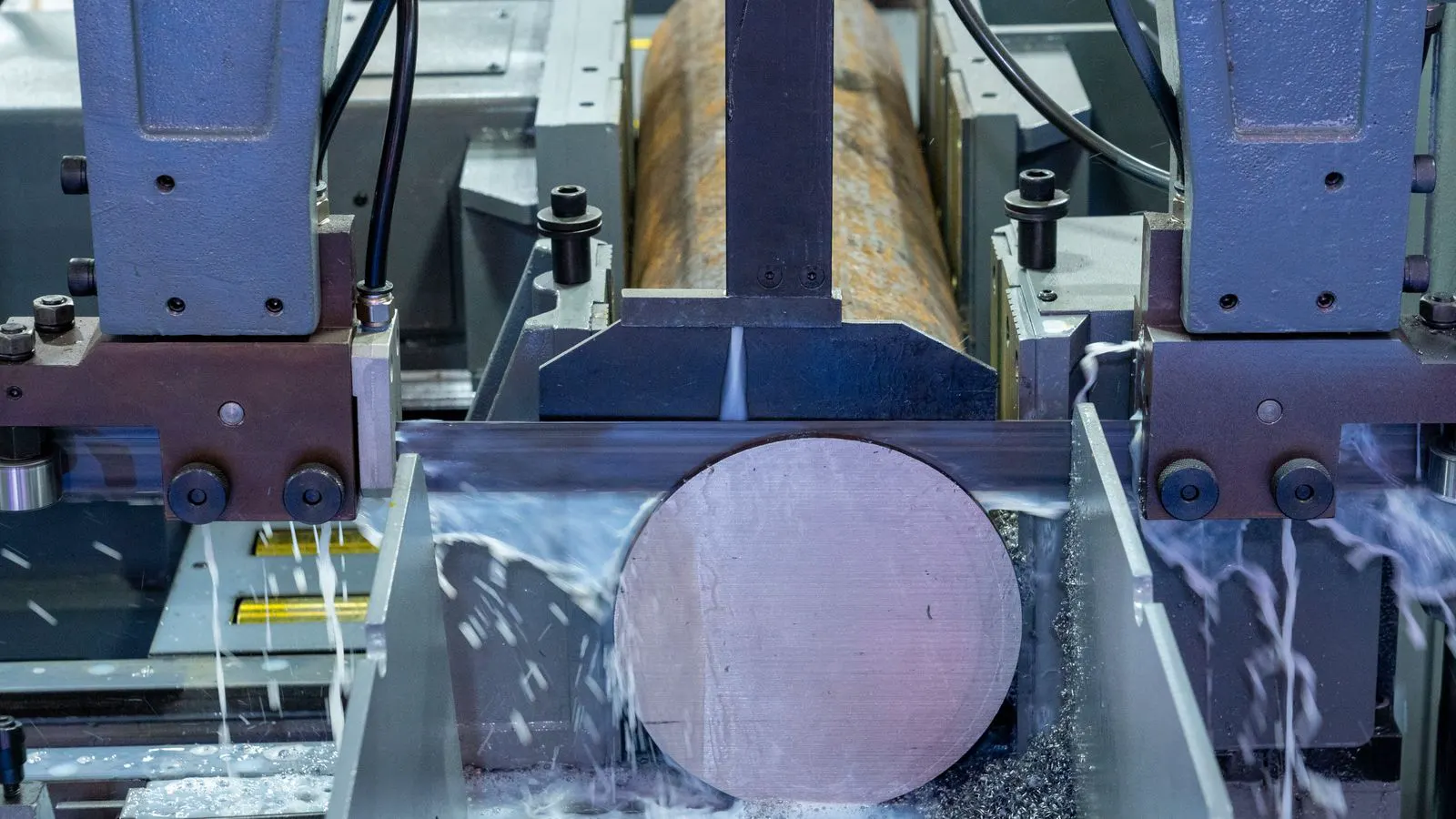
Temperature plays a major role in how much the extrusion moves. Aluminum is sensitive to heat. The saw blade generates heat as it cuts. If that heat soaks into the cut area, the metal expands locally. When it cools, it contracts. The expansion and contraction cycle can add to the existing stress release.
This is why a slow cut with plenty of coolant often produces a straighter part than a fast cut with none. The coolant keeps the temperature uniform. It also reduces the thermal shock on the cut face.
The ambient temperature of the shop matters too. If the extrusion arrives in a cold truck and is cut immediately, the surface and core are at different temperatures. The cut exposes the core to a different environment than the surface. This creates a temporary imbalance. Letting the material sit in the shop for several hours equalizes the temperature before you cut.
How to prevent distortion during your process
Prevention starts before the saw blade touches the metal. The first step is to understand the specific profile. Different shapes hold stress differently. A round bar holds stress more evenly than a complex architectural profile. Ask the extruder for information on the die and the heat treatment condition. If the extrusion was artificially aged, it may have less residual stress than a naturally aged one.
The second step is to manage the cutting process. Use a sharp blade. A dull blade rubs instead of cutting. It generates heat and creates a burr. That burr adds stress to the cut face. Use a miter saw with a slow feed rate. If you are using a band saw, ensure the tension is correct. A loose band creates vibration. Vibration adds stress to the part.
Support is the third step. A long profile needs support on both sides of the cut. If the part is only held at one end, it can pivot during the cut. The movement is small, but it changes the alignment of the stress field. Use a fixture that holds the part without clamping it tightly. Clamping too hard creates local stress points that can cause cracking later.
When to use stress relief heat treatment
Stress relief heat treatment is the most effective way to reduce warping. The process involves heating the extrusion to a specific temperature and holding it there for a set time. This allows the internal stress to dissipate. The metal relaxes into a more stable state.
The drawback is cost and time. You need an oven. You need power. You need a recipe. The temperature and time depend on the alloy and the profile thickness. If you are processing high-value parts, the cost of rework or scrap is usually higher than the cost of heat treatment. If you are processing low-value stock, you may choose to accept the small amount of distortion and compensate with machining tolerance.
Not every extrusion needs heat relief. A short piece cut from a naturally aged bar might not move at all. A long piece of a complex profile will almost certainly move. The decision depends on your tolerance requirements. Measure the movement on a sample batch before committing to a heat treatment process.
How to document and trace the issue
If you are dealing with a specific extrusion lot that behaves poorly, document it. Record the extruder, the die number, the heat treatment condition, and the date of extrusion. This information helps you isolate the problem. If the same extrusion from a different die warps differently, the die is the issue. If the same die warps differently on different days, the process is the issue.
Keep a log of the distortion you observe. Measure the curve in millimeters. Note where it occurs. Is it a bow, a twist, or a flat bend? This data helps you talk to the extruder supplier. It also helps you adjust your cutting parameters. If you know a specific lot warps by two millimeters, you can adjust your saw fence or your fixture to compensate.
How to handle the extrusion safely
Warping is not just a quality issue. It is a safety issue. A distorted profile can shift in a fixture. It can strike an operator. It can break a tool. Always support the part. Never hold a long, thin profile with one hand while cutting. Use a two-point support system. If the part is heavy, use a lift. If it is light, use a clamp.
After cutting, inspect the cut face. Look for burrs. A burr can catch on a machine. It can also create a stress riser that leads to cracking. Deburr the cut face with a file or a deburring tool. This removes the stress concentration and makes the part safer to handle.
How to verify the fix
Once you have adjusted your process, measure the results. Cut a batch of ten pieces. Measure each one. Compare the measurements. If the variation is small, your fix is working. If the variation is large, something is still wrong. It might be the blade. It might be the support. It might be the material itself.
Repeat the test after each change. Do not change two things at once. Change the feed rate. Test. Change the coolant. Test. Isolate the variable. This is how you build a reliable process. A reliable process gives you predictable parts. Predictable parts give you confidence in your final assembly.
Frequently asked questions
Can I prevent extrusion warping by cutting faster?
No. Cutting faster increases heat and vibration. This adds stress to the cut face and usually increases distortion. A slower cut with coolant is more stable.
Does the alloy type affect how much the extrusion warps?
Yes. Different alloys have different thermal properties and stress levels. Some alloys hold more internal stress than others. Always test the specific alloy you are using.
Is heat treatment always necessary for aluminum extrusions?
No. Short pieces or naturally aged stock may not need it. Long, complex profiles usually benefit from stress relief. Test your specific application to decide.
How do I measure the amount of warping?
Place the profile on a flat surface. Measure the gap at the center. For twists, measure the distance between two points on opposite faces. Record the measurement in millimeters.
Can I fix a warped extrusion by straightening it?
Sometimes. You can use a hydraulic press or a manual straightener. The result is not always consistent. It is better to prevent the warping in the first place.